
Dental Crowns Rapid City
Reliable Protection with Customized Dental Crowns
When you hear that you need a dental crown, you may feel immediately panicked at the thought of needing to undergo treatment. Dr. Anderson and our long-standing team offer a number of non-invasive and convenient types of restorations to help rebuild and protect your smile, including same-day, in-house-fabricated dental crowns in Rapid City, as well as dental inlays and onlays. Call us today to schedule a consultation and learn what type of dental restoration can protect your smile with minimal alteration to your natural dental structure.
Why Choose Anderson Dental for Dental Crowns?
- Putty-Free Digital Dental Impressions
- Same-Day Dental Crowns Available
- Experienced & Compassionate Team
Dental Crowns vs. Fillings
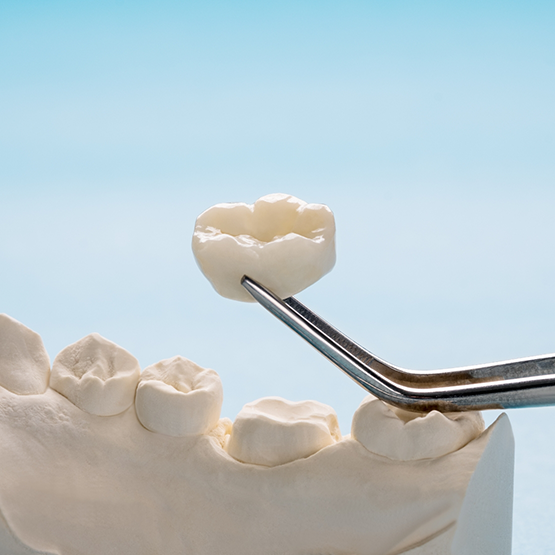
Why do you need a crown instead of a filling? Dental crowns will be suggested by Dr. Anderson when a tooth fracture is suspected or sometimes simply when the filling would be too large to fabricate inside your mouth. The limitation for a filling is size. When fillings become too large or unsupported, they can fail sooner than desired due to limitations on strength in the material and polymerization shrinkage.
Same-Day Dental Crowns
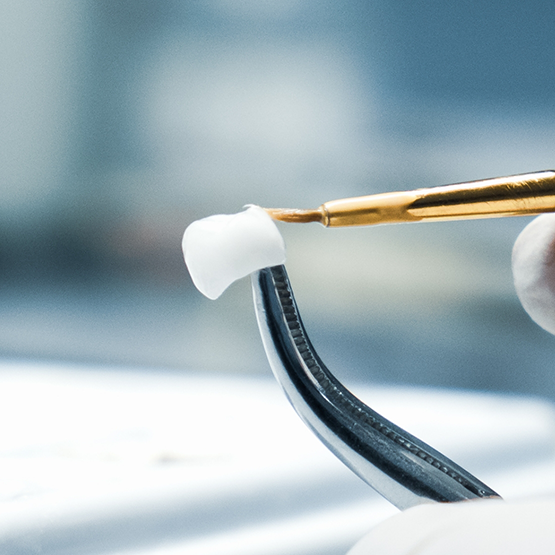
Life is busy enough without having to make multiple trips to the dentist over several days. At our office, we are proud to offer precisely fabricated in-house, same-day crowns.
We scan your mouth with digital 3D camera technology instead of using gooey conventional impression trays. A custom restoration is digitally designed to fit your unique smile while you watch us create it. Your restoration is produced in our office with our state-of-the-art-milling unit. The final, natural-looking restoration is placed in your mouth within just a couple of hours
Your restorations will also look and feel completely natural. Digital precision means a perfectly comfortable fit. Aesthetically, your metal-free restoration will match the look of your teeth for a beautiful and natural smile.
Inlays and Onlays
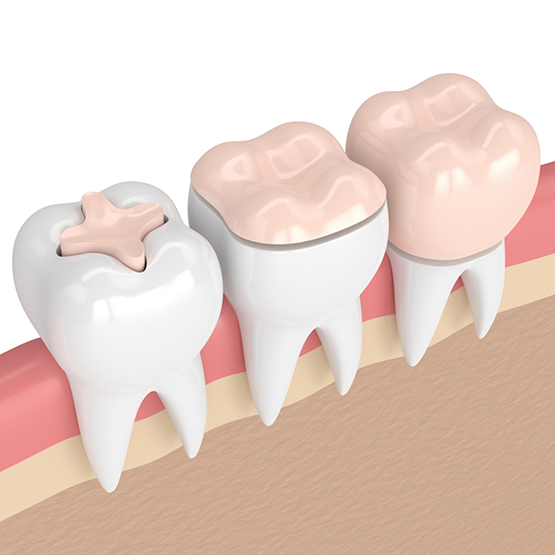
Inlays are fillings fabricated outside of the mouth and then cemented in place. Statistically, an inlay will last much longer than a filling. Because inlays are fabricated outside of the mouth, they are more stable long-term. One of the issues associated with all fillings is polymerization shrinkage. All filling material upon setting shrinks and can contribute to marginal leakage. The larger the filling, the more of this we can expect.
This is one of the biggest advantages of inlays, onlays, and crowns; the outside-of-mouth fabrication creates a stable material that does not shrink in the mouth. Inlays are a superior way to place a filling-like restoration. Inlays are more time consuming and compare to a crown in price.
Onlays are sometimes referred to as a ¾ crown. Instead of covering your entire tooth or all of your cusps with a crown, sometimes it is advantageous to conserve tooth structure and place an onlay instead of a full crown. We will always try to preserve tooth structure for you, and provide you with a restoration that strengthens your tooth. Most teeth that need crowns end up getting full coverage, but there are definitely exceptions that benefit from less coverage and conserved tooth structure.
Understanding the Cost of Dental Crowns
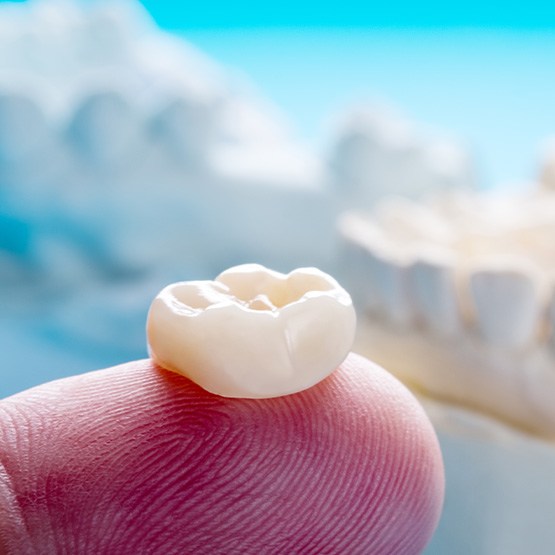
Because dental crowns are a highly customizable treatment, there is no ‘one-size-fits-all’ cost for them. That’s because there are many factors that can affect this. Here’s a closer look at how your dentist determines the price of your dental crown, and a few ways we can help make this treatment better suited to your budget.
Factors that Affect the Cost of Dental Crowns
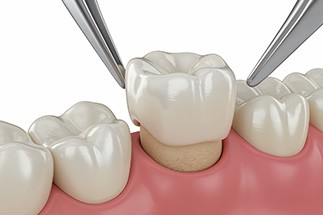
There are several important factors that can affect the cost of a dental crown. These include:
- How severe the damage is to your tooth, and whether other procedures are necessary first, such as a root canal.
- The type of material used to make your dental crown (amalgam, gold, porcelain, etc.).
- How your dental crown is made.
It is also important to remember when having a dental crown made that “cheaper” doesn’t equate to “better.” You want your new crown to not only look good, but also feel good and last for many years, and when it comes to something that will be placed in your mouth, quality matters!
Does Dental Insurance Cover Dental Crowns?

Yes, most dental insurance plans consider dental crowns a major procedure and will generally cover around 50% of their cost if medically necessary. Your dentist’s insurance team will carefully review your individual plan and determine if it covers dental crowns and then maximize your benefits to make your treatment as affordable as possible before treatment begins.
Other Options for Making Dental Crowns Affordable
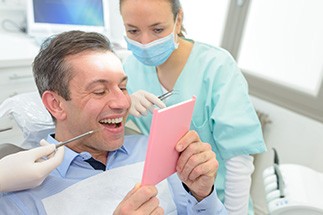
In addition to welcoming dental insurance, at Anderson Dental we proudly accept flexible financing plans through CareCredit. These low-to-no interest plans allow you to break up the cost of your dental crowns into multiple payments that may be better suited to your budget.
Dr. Anderson and the team at Anderson Dental want to help you manage the cost of this important procedure. If you’d like to learn more about your financial options for dental crowns, please schedule a consultation with us today.
Dental Crowns FAQs
Do Dental Crowns Get Cavities?
Dental crowns can’t get cavities, as they’re artificial and lack enamel. That said, the teeth underneath them still can.
The truth is that a crowned tooth has a (slight) risk of decaying. If you neglect it with bad oral hygiene, plaque will form around the gumline where it meets your crown. Bacteria could then travel beneath your cap and further erode your tooth.
All that said, you have the power to prevent cavities in crowned teeth. Just remember to brush twice daily, floss once daily, and see your dentist for regular checkups. Through these habits, you’ll prevent plaque from reaching the areas under your crown(s).
Are Dental Crowns Safe?
So long as qualified dentists place them, dental crowns are quite safe. You can trust them to protect your teeth without causing any harmful side effects.
Note that most dental crowns (including our own) are now metal-free. As such, they don’t contain any mercury – a toxic material that can cause headaches, nerve damage, and similar symptoms. These crowns instead use non-toxic substances like ceramic and zirconia, which are generally harmless.
Still, every dental treatment carries slight risks; crowns aren’t an exception. Please call us if you experience gum irritation, redness, or swelling near the treatment site. These features can indicate an allergic reaction to your crown’s material.
Do Dental Crowns Feel Natural?
Thanks to modern technology, today’s dental crowns feel incredibly natural and lifelike. They won’t cause any “off” sensations once you’ve adjusted to their placement.
These facts are partly due to the crowns’ durable materials. Because the caps use strong ceramic and porcelain, they can withstand chewing forces as easily as tooth enamel. That means eating with a crowned tooth shouldn’t feel strange to you.
That crowns feel natural also stems from how they’re designed and placed. Every crown is based on impressions of your tooth, so each one should fit its treatment site precisely. The one(s) you get won’t cause odd feelings by “jutting out” or sitting poorly.
When Should a Dental Crown Be Replaced?
Only a dentist will truly “know” whether your crown should be replaced. (They can visually examine the cap, take dental X-rays, etc.) Still, warnings signs can indicate that a crown is nearing the end of its life. The most common of these include:
- Pain at the Treatment Site – If your crowned tooth aches, it may be suffering from a cavity. A dentist must remove your crown when the latter occurs to treat your decay.
- Crown Instability – A loose dental crown is typically one that’s stopped working properly.
- A Notably Worse Appearance – When a crown looks chipped or discolored, it can harm your self-confidence. That’s reason enough to replace the cap.
I Need a Checkup & Cleaning I Have a Cavity or Broken Tooth I am Missing One or More Teeth I Want to Enhance My Smile I Want a Straighter Smile I Have a Dental Emergency I am Worried About Gum Disease I Have Jaw Pain & Headaches I am Scared of the Dentist I Have Sleep Apnea/Snore View Our Services